Thursday, March 31, 2011

Poison Prevention


By Meghan

Blog 5 Extra


The most common childhood injury is poisoning.


Every 8 seconds someone calls a poison center.

"A poison exposure occurs when a person swallows, breathes, touches, or gets splashed in the eye with something that can cause sickness or death. Poisoning is a matter of dosage - too much of almost anything can be dangerous."


Each year during March, health agencies nationwide promote information about the risks of poisoning. Many of the precautions seem like a repetition of things we already know and do. When our children started to walk and explore their environment we probably did the basic things to child proof the house. Still this may not be adequate. According to the American Association of Poison Control Centers "in 2007 approximately 1.3 million children under the age of 5 were poisoned." That is almost have the number of poisonings nationwide!  More needs to be done to prevent poisoning in young children. Over time it is easy to grow lacks or overlook situations that in seconds could become extremely dangerous.

Keeping in mind how a toddler or young child might respond to some normal household circumstances, I decided to reexamine some common items that could present opportunities for a young child to be poisoned, and may not have been considered by many parents as much as more familiar poisons.

PLANT DANGERS

Indoor and outdoor plants add to the beauty of our homes and yards. They are selected for many reasons – color, height, to attract butterflies or animals, but few people stop to think if they are safe to be around children. Some parts of many common house and garden plants are poisonous and harmful to humans. I was surprised to learn that certain parts of a plant can be poisonous while other parts are not. Rhubarb stocks are edible, but the leaves are poisonous. When considering plants for your home, check them out first. Label the plants with their names, and keep them out of reach of those little hands. Remember that invisible pesticides and fertilizers may also present risks. The following is an example of the type of informaion available on the website.   


COMMON NAME: Amaryllis
SCIENTIFIC NAME: Amaryllis belladonna, vittata
TOXIC PARTS: Bulb
The amaryllis is a beautiful flower, but the bulbs are poisonous if ingested. Large quantities of the bulb (although less for a small child) would have to be eaten before symptoms of diarrhea, nausea and/or vomiting would occur.

SUBSTANCE DANGERS 

Purses and brief cases are extremely inviting and interesting to young children. These are usually left around without much concern about the common harmful substances that may be in them. Think about it! Pills that look like candy in easy to open containers, nicotine or aspirin that looks like gum, perfume or cosmetics in bright fruity colors, maybe a tube of diaper or acne cream that looks like fun might be inside. All are real dangers for a child. Even a pack of cigarettes could be harmful to your child. The only thing more interesting than Mommy’s purse is one that belongs to Grandma, and she may be more likely to have dangerous medications. Such substances are some of the most common hazards to children. Find a safe place to keep your purse or brief case, and suggest that any visitors do the same.

CHEMICAL DANGERS

Batteries, especially the small round disks, are very dangerous to Mr. Yuk™small children. If swallowed, they cause a chemical reaction in the body. Immediate help is necessary if a battery is swallowed or pushed up a tiny nose. Cleaning proTducts can look like interesting drinks to a child. Chemicals in the garage should be store in a secure cabinet. Never put a dangerous chemical in an unmarked container. Keep them in their original packaging. One of the best deterrents to an accident involving a child is to mark any type of poison with Mr. Yuk stickers.

"To promote poison prevention and the poison center, the iconic symbol  was created by the Pittsburgh Poison Center and was the first recognized poison prevention/poison center awareness symbol in the U.S. Since then, Mr. Yuk has been used to educate children and adults in the U.S. and internationally about poison prevention and to promote poison center awareness.

Mr. Yuk has raised awareness that poison centers are available 24 hours-a-day, every day of the year to assist in the management of poisoning emergencies and to provide poison information. Every Mr. Yuk sticker contains the name of the nearest poison center and the national toll-free “Poison Help” telephone number: 1-800-222-1222. Regardless of your location in the U.S. or its territories, dialing that number will direct your call to the nearest regional poison center."

Follow the Mr. Yuk link to see the promotion, and get the address to receive a free sheet of Mr. Yuk stickers.

LEAD DANGERS

Most families feel that their children are safe from
Lead poisoning, but this might not be true if you live in a house build before 1980! Although the law prohibits lead in toys for toddlers it is still found from time to time. Carefully check “hand –me-down” toys or toys without packaging. Never allow a young child to put jewelry in her mouth. Children’s jewelry frequently has lead or other dangerous metals in it.

CARBON MONOXIDE DANGERS

Most homes have smoke alarms , but not as many have carbon monoxide detectors. Carbon monoxide poisoning causes http://www.the-baby-safety-site.com/carbon-monoxide-poisoning-symptoms.html

flu like symptoms which are much more dangerous to infants and small children than adults. It can also cause lasting effects. Consider getting carbon monoxide detectors for your home, and learn the symptoms and causes of this deadly danger.

Planning for every danger may seem impossible. One of the best way to prevent accidents is to talk to your children. Here are some tips for toddlers and young children.

Tips for Kids


• If you don’t know what something is don’t put it in your mouth. Always ask a trusted grown-up first.

• Never take medicine unless an adult gives it to you.

• Some plants and berries are poisonous. Always ask a grown-up before you put them in your mouth.

• Always let grown-ups use spray cans and bottles. Do not touch them!

• Stay away from things used to clean the house, clothes or car.


Monday, March 28, 2011

Dinner More than Food


The statistics are clear: Kids who dine with the folks are healthier, happier and better students, which is why a dying tradition is coming back. MICHAEL ELINS FOR TIME

Blog 4

By Meghan Scaringi


Even when I was a child having dinner as a family was not the normal thing. My brothers and I had different after school schedules – swimming, dance and music lessons. Sundays were different. On Sundays we had dinner at my Grandmother’s house. Anything we planned on Sunday had to happen before or after dinner. Everyone attend. No excuses. There were times when it seemed like this was terrible, but looking back I see that this was a very special and valuable time – the type of experience I would like my daughter to have.

My daughter is at the stage where she insists on feeding herself. Sometimes this is messing and time consuming. Eating chickpeas with a spoon can take a while. The extra mess makes me wish I could wrap the kitchen in plastic wrap before she eats. She is determined to use her own fork and spoon, and I need to let her try until she learns. Sitting at the table as a family seems to be the place to begin. My daughter wants to do what she sees, and I would like her to have a good example.

Recently, I heard a NPR broadcast of the California Club interview with Laurie David, one of the authors of The Family Dinner:  A Great Way to Connect with  your Kids One Meal at a Time by Laurie David with recipes by Kirstin Uhrenholdt. Basically, this is a cookbook of 75 recipes, conversation starters, tips on teaching green values, and games to play at the table. This seemed like an idea I would like to try, especially where there seems to be so much to gain.

Table manners are not the only thing that can be learned by taking part in family dinner.

• Language Arts –expand vocabulary, storytelling, conversation, listening

• Interpersonal Skills – consideration, respect for others tastes and opinions, cooperation, express thoughts and feelings

• Healthy Eating – balanced meals, portion control, new foods, cooking

• Green Values – use of food, elimination of waste, recycling.

Besides all of this family dinner can build self-esteem, be relaxing and fun!

The list can go on and on. The dinner table is the center for the teaching and practicing not just of table manners but of conversation, consideration, tolerance, family feeling and just about all the other accomplishments of polite society except the minuet. Judith Martin (Miss Manners) writer and etiquette authority

Family dinner with everyone seated at a beautifully set table, eating nutritious food, using proper table manners, while enjoying wonderful conversation sounds very much like a fairy tale from an enchanted life! Still, the advantages are there, and some families are doing it today. There are strategies, as suggested in Laurie David’s book, to create the family dinner that may not happen naturally.

1. Everyone must be present. No excuses. Everyone in the family eats together.

2. No electronic devices. The means television, cellphone, games for children and adults.

3. Involve the children in the preparations. If the children help cook, they are more likely to taste a food. Select simple recipes since adults are role models they should also try to eat verities of food. This is also a chance to use good portion control. With the rise of childhood obesity this is something to consider.

4. Set a pleasant and fun table. China and silver may be unrealistic, but setting the table with proper knife, fork and spoon is a good place to start. A decoration can make it more festive.

5. Don’t make this a time to teach manners. This can only become an unpleasant ordeal. Make some positive suggestions, and let the skills develop over time.

6. Create a positive atmosphere with music. No lyrics, just music as background. This can be an opportunity to sample the taste of other family members.

7. Planning conversation starters until things are more natural is a good idea. Don’t put anyone on the spot!    This should not turn into an inquisition. Share positive accomplishments and achievements.

8. Go green, clean-up

9. Fun Games

Family dinner is a way to de-stress and –if managed correctly- a time to have fun. By that I mean don’t use it as a period of  iinquisition or a recounting of shortcomings. Keep it light, keep it fun, and make it the highlight of the day. Peggy Drexler, PhD, assistant professor of psychology Weill Cornell Medical College.

Family’s that are interested in trying to reinvent the family dinner are able to find ideas and suggestions from the Family Dinner Project.

This sites offers many resources for getting started – checklists, recipes, conversation starters. It is possible to start very simply and build into something special. There is so much to gain from a family dinner; that any effort is worth it.

Friday, March 25, 2011

Professional advice about tantrums

As a mother, a student, and an employee, my life often gets crazy and hectic. After doing this interview and writing this blog, I am afraid to say, for fear of sounding like a bad parent,that I have lost track of what really matters as a mom. I love my children with all of my heart and make sure that they know it, but I have unrealizingly forgot that my actions now, shape my childrens’ lives. How I teach them and react to situations is the example that they will follow. Thinking back, I can recall shopping for my daughter’s birthday party, and they didn’t have the banner I wanted. I stomped my foot and grunted, my husband turned to me that moment and said “I see where Madi gets her temper from.” I guess it was one of those things that never really clicks until it is pointed out. I hope that this interview helps you, as much as it has helped me and opened my eyes to what really matters.


1. What, in your professional opinion, is the cause of tantrums?
"Tantrums are basically a tool used by children to get what they want. In most cases it could be described as a learned behavior that has gotten the results they wanted in the past, so why not try it again? The candy bar at the checkout, getting to leave a place that is uncomfortable or not preferred are possible examples.
There are also children however who lack the resources to control their emotions. Children with autism or developmental issues have a difficult time with changes in routine or unpleasant sensations. The approach with those kids requires a treatment/learning type of intervention that gives the parent the ability to provide the security a child might need to avoid a tantrum."


2. Children tend to act out more in public, what is an acceptable “punishment” for children? At home and in public?
"The work in dealing with inappropriate behavior, including tantrums must take place from the very beginning of child’s life. Parents must understand that they are the first models for positive behavior; it’s tough to tell a child to be under control when the parents lack discipline themselves. Kids will watch and repeat your behavior, so let’s strive to show them a better way to behave.
In training a child to become a good citizen a parent needs to be consistent in what the rules are. Besides what the parent displays, do you correct clearly or explain the behavior that you would prefer? You should try to apply consequences for behavior as quickly and fairly as possible to reinforce what you are trying to teach them. Catch them being good and tell them as fast as you would punish bad behavior.
With that being said, what do you do when your child is spread eagle on the floor in a grocery store screaming because they want something? First, try and acknowledge the situation, without ranting yourself, remain calm and remind them of potential consequences for the behavior and what you expect them to do. Do this with firmness. Don’t get yourself out of control. Secondly, if they don’t respond the way you want, you’ve confronted them firmly, tried to ignore the behavior, then be willing to leave the store with your child. You’ll be embarrassed but most people would completely understand and sympathize with your situation. I have done this. I have taken the child to the car and dealt with them outside of the public. I’ve left the cart with an attendant in the store to keep until or if I return. Again, give your clear explanation of the behavior, even expressing disappointment (it’s ok to make them feel badly for hurting you). Make the car a place for a ‘time out’ and remind them of other consequences if they continue to misbehave.
If they settle, return to the store, if they can’t demonstrate that they won’t act up again, leave and live to fight another day. The key is to either get the child settled or remove them from the situation quickly because it is tough to have this unfold for an extended period in public, you need to be firm and feel as confident as possible."


"One last note, DO NOT use a bribe to get the child to behave. They need to learn that proper behavior is expected and not to be subject to bargaining. When you give in, you only give the child another experience that tells them tantrums work!"


3. How can a parent prevent this unacceptable behavior?
"As I said before the real work needs to be done beforehand. Your prevention is in the willingness to teach and train your children as often as possible. Let them know the rules and reward when they do well as you would if they misbehave.
I recall a ‘look’ that my mother could give me to show me that I was getting into trouble. That look was both a warning and a punishment together and it could stop me in my tracks across a room. My spine is melting right now remembering that glare!"


4. They call this stage of a child’s life “terrible two’s”, but as most parents find out this stage lasts longer then 2 How can we shorten this length of time?
"Again, be willing to put the time in throughout your child’s life. The 2’s set the standard for things to follow but it doesn’t end there. It’s about demonstrating your love for the child in that you are willing to take the time to focus on them, engage, teach and encourage them to get the best out of life. Parent out of love, parent to teach goodness and give your child the best of what you have to offer.
But remember, mistakes will probably be made, don’t get overwhelmed. Kids and parents are resilient. If you have made a mistake, be willing to apologize, even to your kids. You don’t lose face but in fact, you demonstrate another example of how people should be with others and how you are willing to learn, just like they should be."

I hope you enjoyed the interview!


Check out my next blog on April 8th,where I will cover sibling rivalry .


Special thanks to:
John Dittmar, who has his masters in education, is a licensed therapist, and is a PhD Candidate.

Alisha O.

Wednesday, March 23, 2011

TEENAGERS AND PEER PRESSURE

By:  Tina  

“Do your homework.”  “Clean your room.”  “Take out the garbage.”  Sound familiar?  These parental urgings echo in most teenager's ears and many times, receive little if any response.  Now suppose your teenager’s friends are encouraging him or her by saying “Come on, take a drink.”  “Let’s skip school today.”  “Let’s have some fun and paint graffiti on the high school.”  I wonder how your teenager would react.

What exactly is peer pressure?  When a teenager’s friends influence their thoughts and behavior, that is peer pressure.  This influence can be verbal, nonverbal, and even unconscious.  This pressure can negatively or positively impact your teen’s behavior.  Peer pressure is a powerful influence, one that all parents need to understand. 

Why is peer pressure so powerful?  Research suggests that a teenager’s task is to make a break from their parent’s influence and identify with the value of their peers.  Let’s face it, teenagers spend many more waking hours with their peers as opposed to family members.  Friends seem to become the utmost important thing in a teenager’s life and fitting into that group of friends is a crucial task.  Teenagers seem to “try on” different thoughts, ideas and lifestyles that their friends can offer.  They try to break away from the values and standards that parents have instilled in them in an effort to discover themselves.

The fact is that an adolescent brain is a work in progress.  It constantly seeks new experiences but it does not have the ability to say, “This could be harmful to my health.”  Additionally, the teen brain seems to have a higher need for new, exciting and intense stimulation.  However, new, exciting and intense experiences may translate into “risky” behavior.  Because a teenager’s brain is seeking this new stimulation and can not always put the brakes on a bad idea, a friend’s suggestion to partake in a risky behavior is tempting regardless of the consequences. 

What can teenagers do to get a handle on all of this pressure?  Here are a few suggestions from teenhelp.com.  You can read the entire article at: http://www.teenhelp.com/teen-issues/peer-pressure.html

  • Decide what your values and standards are before you get into a situation.
  • Choose good friends who share your values.
  • Avoid situations where people are doing things you do not want to do.
  • Think about your reasons and the consequences of your decisions and actions.
  • Practice ways to say no.
  • Talk to your parents or a trusted adult about the kinds of peer pressure you face and listen to their  advice.
  • With you parents or another trusted adult, come up with a code word you can use to let the adult know that you need help getting out of a bad situation but can’t talk about it.                         
What can parents do to deal with peer pressure?  Here are a few suggestions:

  • Remember that you are one of the biggest influences on your teen.
  • Remember that it may seem like your teen is not listening to you, but they truly are listening.
  • When parents stay involved in their teen’s lives, the teen tends to make better choices for themselves.
  • Stay interested and involved in what your teen is doing and be aware of what he or she is up to.
  • Be consistent with your message about expectations.  If you expect that your teen will not drink, smoke, do drugs or have sex, chances are he or she will be less likely to do so.  It really is as simple as that.


Source:
Herman, Judith W. “The Teen Brain as a Work in Progress: Implications for Pediatric Nurses.” Pediatric Nursing. 2005 31(2): 144-148.

Monday, March 21, 2011

Dinner Bell!!!!!

By:  Christina C


There are some days that I spend all day thinking, “What am I going to make for dinner tonight?” The easiest choice is to make a phone call and order pizza or go to the nearest restaurant. These two choices are not only the more expensive choice but also sometimes not the most nutritious. Dinnertime in our house is the family meal; this is the time that we sit down together. We share about our day, what our plans are for the next day and enjoy each other’s company. My family is always on the go, setting aside time to sit down and talk is hard in hectic schedules. I want the food to not only be delicious but nutritious. Nutrition is something I strive for with every meal but dinner is a special meal. I believe that breakfast is the most important to start your day off right and dinner is important to complete your day.


Dinner is defined in the dictionary as the chief meal of the day, eaten in the evening or at midday. It is said that most toddlers received 85% of their needed nutrition through out the day therefore they are less likely to eat a full meal at dinnertime. It is hard to decide what to make for dinner that you know your toddler will eat as well.


Making a meal for the adults and a meal for your toddler can be nerve-racking. If you know what you have eating for dinner your toddler will not eat, try mixing up something that they just may try. An example would be, cutting chicken off of your baked chicken and serving to your toddler as nuggets. If you are having hamburgers, mash the ground meat and mix with noodles and a small amount of beef broth for flavor.


Some toddlers just will not eat their meals. Jessica Seinfeld has written a book called “Deceptively Delicious” is about how to get your child to eat nutritiously without the battle at dinnertime. She describes how to “hide” vegetables into their favorite meal so they still get the nutrition from vegetables but without the stress of fighting over it. There is also another book that does not go down the hiding route but is a lot of easy nutritious meals that the whole family can eat. It is called “The Big Book of Recipes for Babies, Toddlers & Children: 365 Quick, Easy, and Healthy Dishes” by Bridget Wardley. This book I personally have just purchased and so far have no complaints.

A typical dinner in our house normally consists of a protein, a vegetable and a grain. The food pyramid for toddlers suggests that a toddler should consume three ounces of grain, one cup of vegetable and two ounces of a protein. By following this it will occasionally make my choosing what is for dinner job easier. Some days my toddler will eat the vegetables and not the protein and some days it is the opposite. Now if only I could get my toddler sit still long enough at the dinner table to enjoy her meal. That is a discussion for another day!


Work Cited:


1. "Dinner." The American Heritage® Dictionary of the English Language,
     Fourth Edition. Houghton Mifflin Company, 2004. Answers.com 19 Mar.  2011.     http://www.answers.com/topic/dinner

. Seinfeld, Jessica. Deceptively Delicious: Simple Secrets to Get Your
    Kids Eating Good Food. Collins; 1st edition 5, October 2007

3. Wardley, Bridget. The Big Book of Recipes for Babies, Toddlers & Children:
    365 Quick, Easy, and Healthy Dishes. Duncan Baird. 28, July 2006

4. Wholesome Toddler Foods
     http://www.wholesometoddlerfood.com/toddlerdinners.htm
     Cited: March 30, 2009 Retrieved: March 19, 2011

5. Wholesome Toddler Foods
     http://www.wholesometoddlerfood.com/pyramid.htm
     Cited: March 30, 2009 Retrieved: March 19, 2011


Friday, March 18, 2011

Children and Values

Like most parents I want my children to grow-up to be good people. They don’t grow-up to be nice just because we want them to, they have to be taught. It is easier to teach good values to children at a young age. I feel it is the parent’s responsibility to instill these in their children. I think that teachers and other family members also play a role in teaching them as well. Children learn and observe a lot from their environment and we have to teach them what is right and wrong. Here are a few values I feel should be taught to every child.


Honesty
When children are young they always speak the truth and don’t know you can hide the truth. As they get older they are influenced by peers, adults and fears. It is very important for parents to make the child understand that speaking the truth is always better and that’s how you build trust.


Love
Children need to be taught to give love that is unconditional. Learning to forgive and forget and love someone despite their faults will help them to be a much happier adult.


Manners
Good manners are important to have. Children need to be polite by saying “Please” and “Thank you” and apologizing when they do something wrong.


Respect
Children learn to respect parents, teachers, rules and laws. It’s important that children learn that everyone has their own opinion and their own likes and dislikes.


Responsibility
Children can be taught to have responsibility by giving them chores to be done on a daily basis and also taking responsibility for their actions. This teaches a child to value things that are done for them and to be held accountable for their behavior.

Sharing
Children need to be around other children so that they learn to be caring and share. Learning to share helps children mature and may eliminate selfishness even when they are an only child. I feel these are some of the most important values a child can be taught.


These values help shape them into a good, kind person. Most children learn best by watching and imitating others and if the parents set a good example for their child then these values will be easier for the child to learn. As I always tell my children, it’s important to treat others the way you would like to be treated.


For more information on teaching values visit: www.parents.com/kids/responsibility/values/


Melissa K

Thursday, March 17, 2011

TEXTING AND TEENAGERS

TEXTING AND TEENS               

By: Tina

No matter what generation you come from teens seem to be constantly on the phone.  However, teens of today are doing much more texting than talking.  According to a study conducted by Pew Internet and American Life Project, one-third of teens in the United States text more than 100 times per day.  Text messaging is by far the most common way that teens between the ages of 12 and 17 communicate with each other.  On average, girls send about 60% more text messages per day than boys.  Cell phone texting has become the preferred channel of basic communication between teens and their friends, with cell calling coming in at a close second.  Among all teens, the frequency or use of texting has now overtaken the frequency of every other common form of interaction with their friends.  


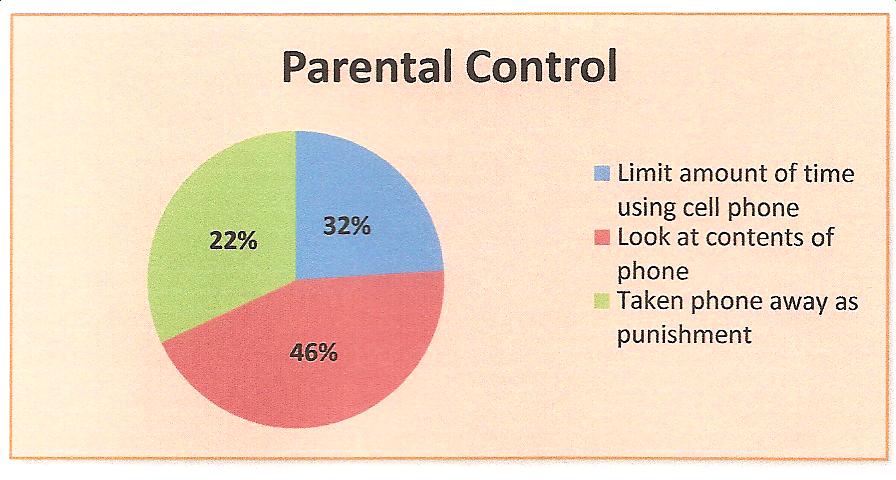
Texting has become a centerpiece in teen social life.  Not only do teens use cell phones for calling or texting, but also to access the internet and to take and share photos and videos.  Parents and teachers have grown increasingly concerned about the role of cell phones in the lives of teens and young adults.  So why do parents permit their teenagers to have cell phones?  Most parents say the use of cell phones will allow them to stay in touch with their teen no matter where they are.  That may be true but parents also need to consider and exercise some control over the use of those phones.  I recently conducted a survey of 50 family members, friends, and co-workers asking them three basic questions about parental control over their teen’s cell phone.  Take a look at the graph below for the results. 

I was very pleased to learn that almost half of the people surveyed said that they check the contents of their teen’s cell phone regularly.  It is a good habit for parents to be aware of who your teenager is communicating with and what they are talking about.  As mentioned earlier, teens also use cell phones to send pictures and videos to each other creating another concern for parents called sexting.  I was shocked to learn that this is the newest “crave” among teens.  Sexting is sending sexually nude, or nearly nude, images or videos of yourself to someone else via text messaging.  A new survey from the Pew Research Center’s Internet & American Life Project found that 4% of teens admitted that they have sent sexually suggestive text messages, and 15% of teens admitted to receiving such messages. 

Could all of this texting be harmful to your teen’s health?  According to WebMD Health News, teens that are considered “hyper-texters”, defined as texting 120 or more messages in a school day, run a greater risk of trying cigarettes, engaging in underage drinking and fighting, and experimenting with illegal drugs and sex.  Research also reveals that too much texting and social networking are also linked to obesity, eating disorders, school absenteeism, lack of adequate sleep, and feelings of being unsafe at school.  These are actual facts from a recent study conducted by researchers at Case Western Reserve School of Medicine 
http://case.edu/think/breakingnews/hypertexting.html.  It is apparent that if left unsupervised, texting can have dangerous health effects on teenagers. 

Please allow this information to serve as a wake-up call for all parents to not only help their teenagers stay safe, but also to discourage excessive use of cell phones and texting in general.